Reducing inference cost in Mol-JEPA and Boltz-2
Original models: Mol-JEPA, Rottach et al. · Boltz-2, Passaro et al. · STATE, Arc Institute.
compressme technical report · 8 September 2026
For SMILES-only inference, we reduced the tested Mol-JEPA checkpoint by 56.47% of its parameters while retaining all embedding outputs. Complete calls ran approximately 2× faster on an Apple GPU. In Boltz-2, sharing identical weights between the confidence and affinity checkpoints saved 49.55% of their jointly loaded registered weight storage.
The Mol-JEPA result combines input specialisation, algebraic composition and sparse execution. Boltz-2 keeps the original computation and stores shared weights once. Neither result required retraining, distillation or precision reduction.
Mol-JEPA: reduce the active computation
The original multimodal checkpoint has 45,406,721 float32 parameters. For this
experiment, the input contract accepts SMILES with embeddings_data=None and
rejects additional modality inputs. The model still returns all 12 predicted
modality embeddings, the CLS vector, all 13 latent embeddings and requested
attention maps.
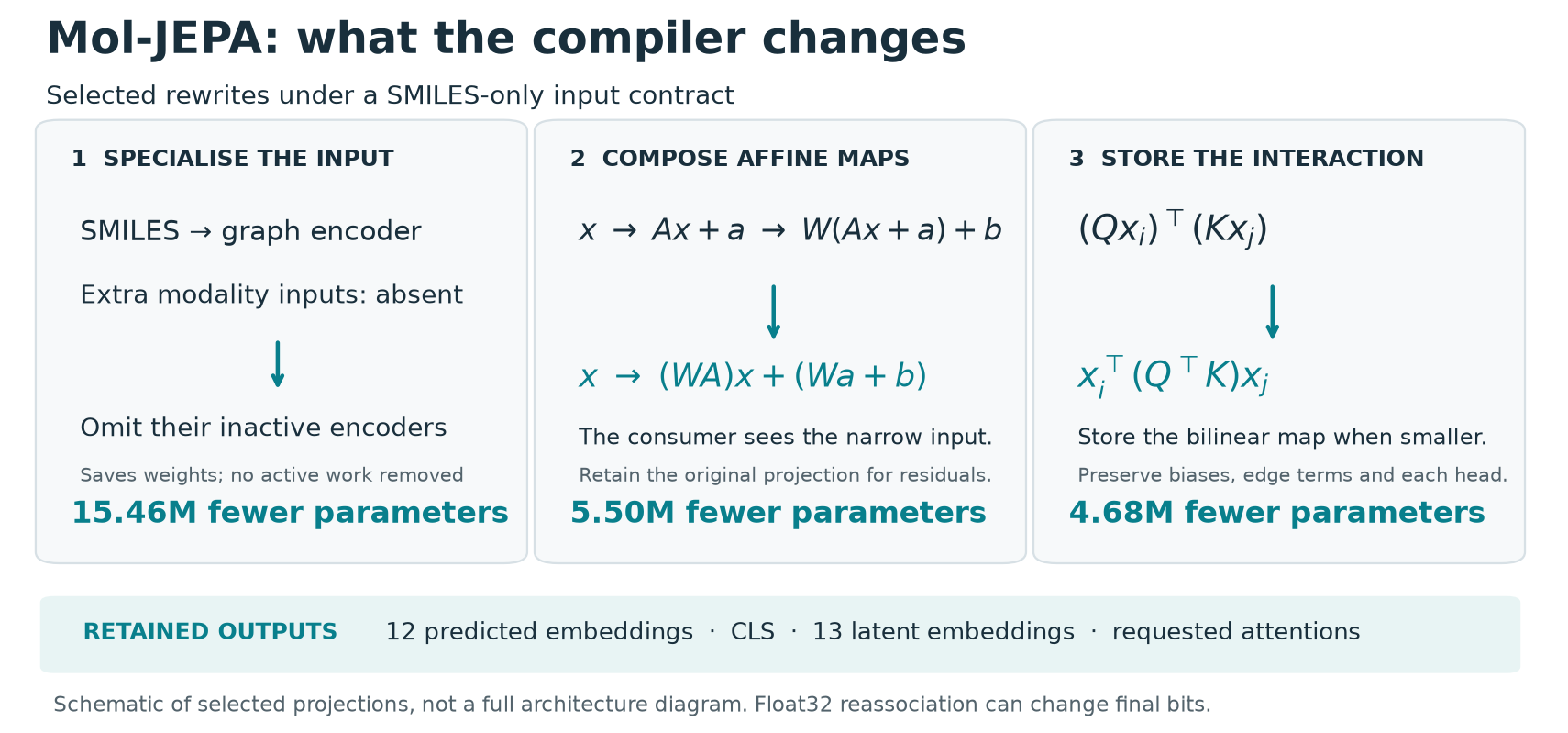
Figure 1. The input contract removes unused encoders. Algebraic rewrites replace oversized intermediate projections with the combinations consumed downstream. The diagram is schematic; residuals, biases, edge terms and output branches remain.
Three reductions account for the complete parameter change:
| Transformation | Parameters removed | Why it applies |
|---|---|---|
| Omit encoders for absent input modalities | 15,462,401 | Those branches are unreachable under the declared SMILES-only contract. They already performed no inference work on this route. |
| Compose the narrow atom projection with its first-layer consumers | 5,504,000 | W(Ax+a)+b = (WA)x+Wa+b; consumers can operate on the original 82-feature input. The original expansion remains where the residual needs it. |
| Store eligible query/key interactions as bilinear maps | 4,677,160 | The attention score observes QᵀK, allowing a smaller interaction representation while preserving each head and its edge terms. |
| Total | 25,643,561 | 45,406,721 → 19,763,160 retained parameters |
Removing the unused input encoders leaves 29,944,320 parameters. The affine and attention rewrites then remove another 10,181,160, or 34.00% of that SMILES-specialised model. This separates the benefit of narrowing the input API from the reduction in the representation used for inference.
Sparse bond-only graph preparation, graph kernels that avoid large edge-message intermediates, fewer device synchronisations and batched readouts then improve execution. These changes retain all output heads and add no further parameter reduction. The measured speedup combines these execution changes with the parameter rewrites, so the parameter count alone does not explain it. Derivations and prior art.
Complete-call timing and output agreement
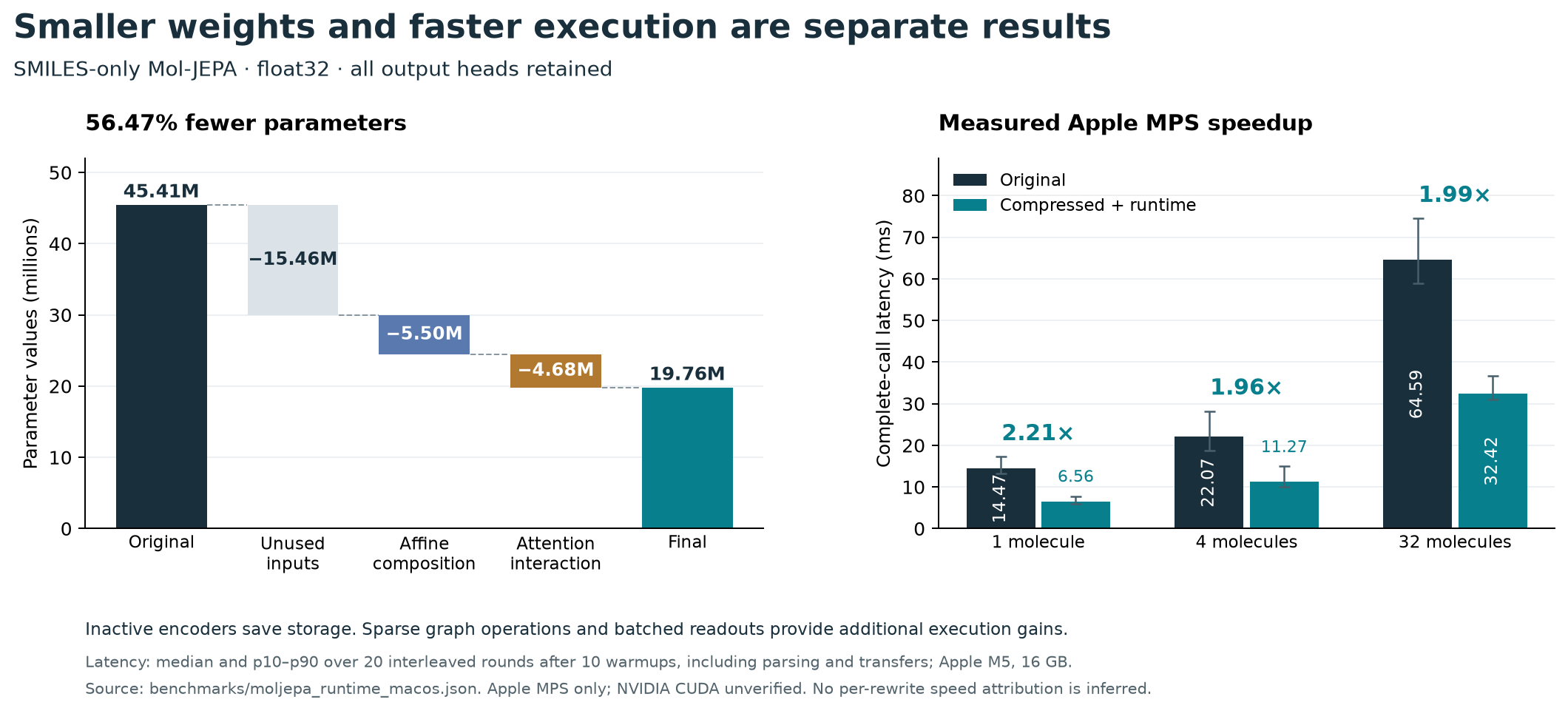
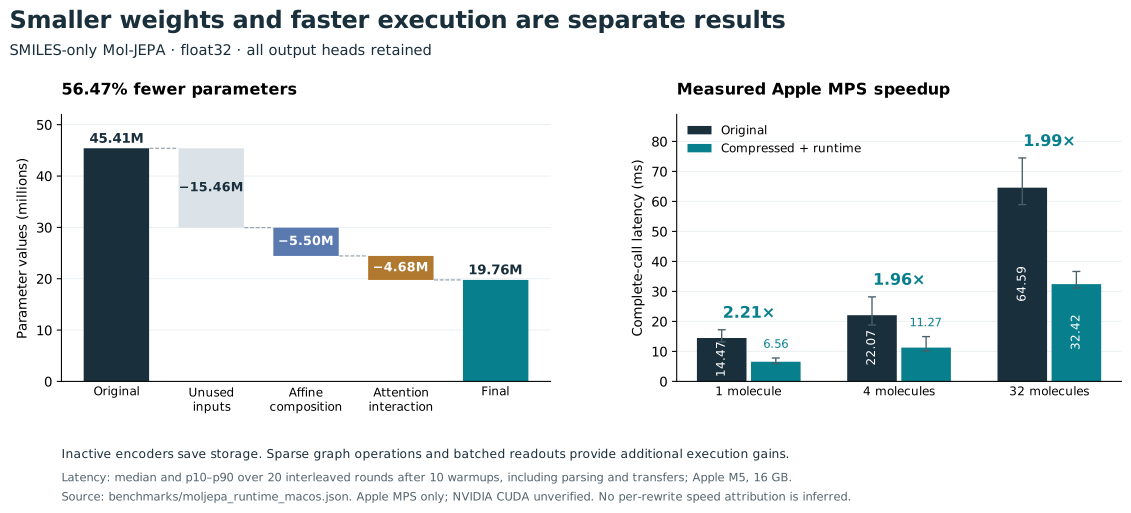
Figure 2. Left: exact parameter accounting. Right: complete-call median latency; error bars show empirical p10–p90, not confidence intervals. The original and compressed models receive the same SMILES inputs. Editable SVG · Data provenance.
The reference timing run on 7 September used an Apple M5 MacBook Air, 16 GB unified memory, Python 3.12 and PyTorch 2.14. Each workload had 10 warmups and 20 shuffled, synchronised rounds. Timings include fresh SMILES parsing, graph construction, device transfers and every prediction head; loading and first-call shader compilation are excluded.
| Molecules per call | Original median | Compressed median | Speed ratio |
|---|---|---|---|
| 1 | 14.47 ms | 6.56 ms | 2.21× |
| 4 | 22.07 ms | 11.27 ms | 1.96× |
| 32 | 64.59 ms | 32.42 ms | 1.99× |
All 64 validation SMILES passed complete output and requested-attention checks. The largest absolute difference was 2.15×10⁻⁶ on MPS and 4.05×10⁻⁶ on CPU. The algebra is exact over real numbers; reassociating floating-point operations can change the last bits. These measurements establish agreement on the tested inputs, rather than universal byte identity. Full timing samples and output metrics.
A fresh MPS revalidation on 8 September passed all 33 SMILES-suite cases and 133 output-tensor comparisons, with the same 2.15×10⁻⁶ maximum error. Repeating the original model itself changed outputs by up to 1.59×10⁻⁶. Numerical tolerance and byte identity therefore measure different aspects of agreement. Fresh GPU checks.
Boltz-2: share identical checkpoint weights
Boltz-2's confidence and affinity checkpoints have 5,019 common named tensors with identical bytes. Sharing immutable parameter storage reduces the jointly loaded models from 4.087 to 2.062 GB of registered weights, a 49.55% saving. Logical parameter enumeration and original arithmetic remain unchanged.
All 48 returned tensor outputs matched the original bytes on CPU and MPS, including fresh reloads, for one 20-residue protein/ethanol fixture with the standard 200-step schedules. This saving applies when both models are loaded together; sequentially unloading one model has a different memory baseline. We did not establish a single-model speedup. Optional conditioning reuse gave no reliable MPS gain. Boltz evidence and limits.
How this relates to existing tools
Program specialisation, affine composition, tabulation and weight deduplication are established techniques. Joint query/key compression also has prior work; the useful application here handles Mol-JEPA's oversized graph-attention heads, including their biases and edge features. The methods notes attribute these ideas and state the conditions of each rewrite.
The practical contribution is finding where these reductions apply to published checkpoints, retaining the requested outputs, and providing reproducible exports and measurements. ONNX Runtime already offers graph optimisations and shared weight initializers. It is a relevant deployment baseline. The approximately 2× Mol-JEPA result above compares with the recorded original PyTorch workflow; it does not establish a speed advantage over ONNX Runtime. A separate four-molecule CPU test found that applying the structural rewrites before ONNX export improved ONNX Runtime calls by 1.63× in median paired timing, with the same original preprocessing and all embedding and attention outputs. That fixed-shape test has its own ONNX Runtime results and limits.
Transferability and limits
The same passes can apply wherever the model's dataflow supports affine composition, normalisation statistics, fixed-vocabulary evaluation or immutable storage sharing. Model names do not determine eligibility. Unsupported or incompressible models remain unchanged, and each local rewrite must also pass complete-output comparisons in the enclosing model.
The GPU evidence covers Apple MPS. NVIDIA CUDA remains unverified because no NVIDIA GPU is available. STATE SE's 28.67% parameter reduction remains CPU-only. A separate lossless representation of its original table preserves all tested output bytes on CPU/MPS after reload and saves 6.31% of registered state. Decoding makes the tested MPS calls about five times slower, so this option trades execution time for smaller storage. STATE details. Backend-specific kernels and precision settings can change floating-point results, so CUDA requires its own comparisons against an original CUDA reference. GPU validation guide · PyTorch numerical accuracy.
These tests measure preservation of pretrained outputs. They do not establish downstream biological accuracy or unrestricted fine-tuning equivalence. The supporting research notes retain smaller gains and negative experiments. The CLI can inspect and pack weights without biology dependencies; semantic rewrites require a trusted local model constructor and representative inputs.